Blog > Which Type of Real Estate Is Best to Buy?

Walk into any conversation about real estate investing or home buying and someone will confidently declare that one type of property is universally better than all the others. Single-family homes are the safest bet. Condos are the best entry point. Multi-family is the only path to real wealth. The reality is more nuanced than any of those claims, and the right property type for any given buyer depends on their financial situation, their goals, their available time, and the specific market they are buying in. Here is a clear-eyed look at each major property type and who it actually makes sense for.
A quick overview of the main property types



1. Single-family homes
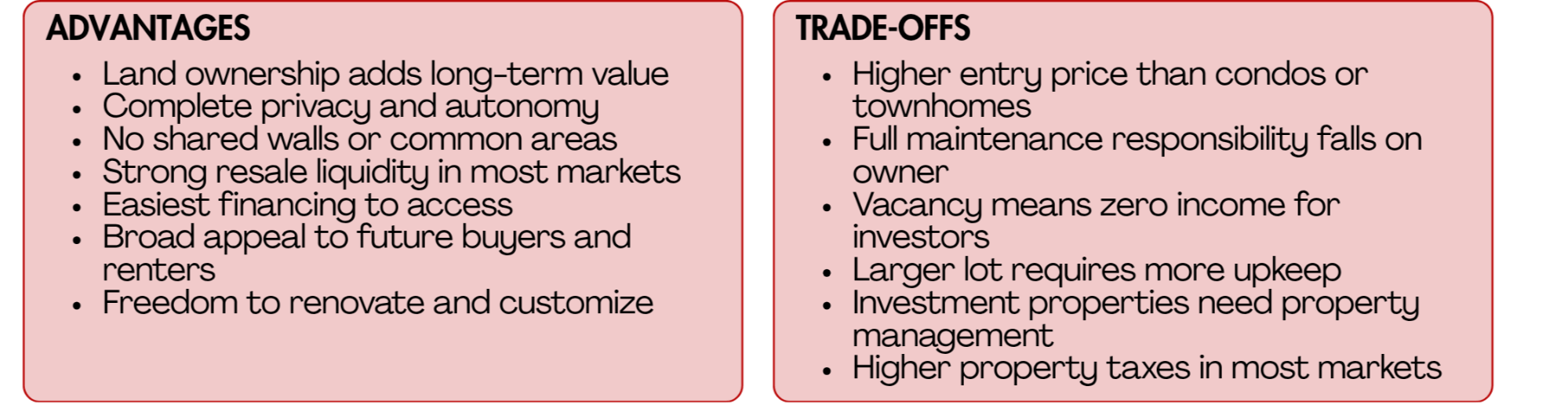
The single-family home is the most familiar and most widely purchased type of real estate in the United States, and for good reason. It offers a combination of privacy, land ownership, customization freedom, and long-term appreciation potential that no other property type fully replicates. For buyers who plan to live in the home, a single-family property gives them complete control over their space, the freedom to renovate and improve as they choose, and the ability to build equity in an asset that typically appreciates reliably over time in well-chosen locations.
For investors, single-family homes are the most accessible entry point into real estate investment, with financing options that parallel primary residence mortgages, a broad tenant pool of renters who prefer a house over an apartment, and resale liquidity that tends to be stronger than most other property types. The trade-off is that a single-family rental generates income from only one unit, which means a vacancy leaves the investor covering the full mortgage without any offsetting rental income until the property is re-leased.
2. Condominiums
A condominium gives the buyer ownership of the interior unit while the exterior structure, common areas, and shared amenities are jointly owned and maintained by the homeowners association. This structure shifts most exterior and structural maintenance responsibilities away from the individual owner, which makes condos particularly appealing to buyers who want the financial benefits of ownership without the time and attention demands of maintaining a house and yard.
Condos typically offer a lower purchase price than comparable single-family homes in the same area, making them an accessible entry point for first-time buyers, urban professionals, retirees seeking low-maintenance living, and investors looking to enter a market at a lower cost basis. The trade-off is that condo owners pay monthly HOA fees that can be substantial depending on the building's amenities, that they have less control over the property than a house owner would, and that appreciation tends to be slower and less consistent than single-family properties in the same market.

3. Townhouses
A townhouse occupies a middle ground between a single-family home and a condo that appeals to buyers who want more space and privacy than a condo offers but at a lower price point than a comparable detached house. Townhouses typically share one or two walls with neighboring units but have their own entrance, often a small private yard or patio, and in many cases a garage, which gives them a more house-like feel than a standard apartment-style condo unit.
From an ownership structure standpoint, townhouses can be either fee-simple, meaning the owner owns the land the unit sits on, or condominium-style, meaning the land is jointly owned. The distinction matters for financing and long-term value, so it is worth clarifying before purchase. Like condos, most townhouse communities are governed by an HOA that covers exterior maintenance and shared amenities, which reduces the owner's maintenance burden relative to a detached house.

4. Multi-family properties
Multi-family properties, which include duplexes, triplexes, fourplexes, and larger apartment buildings, are the preferred entry point for buyers who want to generate rental income from real estate rather than simply build equity through appreciation. The fundamental advantage of multi-family over single-family investment properties is that multiple rental units generate income streams that offset the mortgage, and a single vacancy does not leave the investor covering the entire cost of ownership alone.
House hacking is a strategy that has gained significant popularity among younger buyers and first-time investors, and multi-family properties are the vehicle that makes it work. The concept is simple: you buy a duplex or triplex, live in one unit, and rent out the remaining units. The rental income from the tenant-occupied units offsets or sometimes fully covers your mortgage payment, allowing you to live in the property at significantly reduced or even zero net housing cost while building equity and accumulating real estate experience as a landlord.

The trade-off with multi-family investing is that being a landlord requires time, attention, and the willingness to deal with tenant issues, maintenance coordination, and the occasional difficult situation that comes with managing other people's housing. Buyers who are not prepared for that reality often find the landlord role more demanding than they anticipated, which is why honestly assessing your temperament and available time before purchasing a rental property is just as important as analyzing the financial returns.
5. Vacation rentals and short-term rental properties
Vacation rental properties have attracted enormous investor interest over the past decade as short-term rental platforms made it easier than ever to generate income from a property when you are not personally using it. The appeal is straightforward: nightly rental rates in desirable vacation markets can be significantly higher than long-term monthly rent divided into nightly equivalents, which means a property rented successfully as a short-term rental can generate more gross income than the same property leased to a long-term tenant.
The challenges are equally real. Short-term rental income is variable and seasonal, requiring active management of bookings, cleaning coordination, guest communication, and maintenance that a long-term rental largely automates through a stable tenant relationship. Regulatory environments for short-term rentals have also tightened significantly in many markets, with cities and HOA communities restricting or banning short-term rentals in ways that can eliminate the income strategy entirely after a purchase has been made.

6. Raw land
Buying raw land is the most speculative of the common real estate investment types and the one that requires the most patience and the most specific knowledge of local development patterns, zoning, and infrastructure plans to evaluate intelligently. Land generates no income while you hold it, requires payment of property taxes and potentially carrying costs throughout the holding period, and can be highly illiquid in markets where demand for land is not active.
The potential upside of land ownership is significant in the right location and at the right time. Land in the path of development, purchased before infrastructure reaches it and prices reflect the area's potential, can appreciate dramatically as a growing metropolitan area expands outward and demand for buildable sites increases. Several of the most significant wealth creation stories in Arizona real estate over the past several decades have involved buying land at the right time in what is now the East Valley and holding it through the growth cycle.
For most buyers and investors without specific land development expertise or local market knowledge, raw land is a risky starting point for real estate investment. It is better suited to experienced investors who understand the regulatory environment, have the financial patience to hold without income, and have done the specific research required to evaluate a parcel's development potential accurately.
Matching the property type to your goal
Rather than asking which property type is best in the abstract, the more useful question is which property type best matches what you are actually trying to accomplish. Here is how different goals typically map to different property types.
- Building long-term wealth through appreciation. Single-family homes in well-located, supply-constrained markets tend to offer the most consistent long-term appreciation track records.
- Generating immediate rental income. Multi-family properties, particularly small residential buildings like duplexes and triplexes, offer the best income relative to purchase price for most beginning investors.
- Reducing your own housing costs. House hacking a multi-family property lets you live in the home while tenants help cover the mortgage, reducing your net housing expense significantly.
- Low-maintenance lifestyle as primary residence. Condos and townhouses with active HOAs offer the ownership benefits of real estate without the full maintenance burden of a detached house.
- Personal enjoyment combined with income. Vacation rental properties in strong short-term rental markets offer the ability to enjoy the property personally while generating income when you are not there.
- Long-term speculative growth. Land in the path of development offers the highest potential upside and the most significant risk, best suited to patient and knowledgeable investors.
What the Phoenix East Valley market tells us about property types
In the Phoenix East Valley, including communities like Gilbert, Chandler, Queen Creek, San Tan Valley, and Scottsdale, single-family homes have historically delivered some of the strongest appreciation in the entire national market, driven by population growth, strong employment, excellent schools, and a quality of life that continues to attract buyers from across the country. For buyers in this market focused primarily on building wealth through appreciation, single-family homes in well-located East Valley communities have a strong track record that is difficult to argue with.
Multi-family properties in the East Valley are more scarce than in denser urban markets, which makes them more competitive to acquire but also means that rental demand for the units tends to be strong and consistent. Condos and townhouses offer meaningful entry points for buyers priced out of detached homes in the most competitive East Valley zip codes, and vacation rentals near Scottsdale's resort corridor continue to generate investor interest despite the regulatory environment requiring careful pre-purchase research.
The bottom line
There is no universally best type of real estate to buy because different property types serve fundamentally different purposes and perform differently depending on the market, the buyer's financial situation, and the goals they are trying to achieve. Single-family homes offer the most familiar path to long-term wealth building through appreciation and the most straightforward route to primary homeownership. Condos and townhouses offer accessible, lower-maintenance alternatives for buyers who prioritize lifestyle or affordability over maximum space and control. Multi-family properties offer the most direct path to rental income and the house hacking strategy that can dramatically reduce a buyer's net housing cost. Vacation rentals offer income potential combined with personal enjoyment in the right markets with the right regulatory environment. And land offers speculative upside for patient, knowledgeable investors willing to hold without income through a development cycle. The best type for you is the one that honestly matches your goals, your financial position, your available time, and the specific market where you are buying.
GET MORE INFORMATION
