
Blog > What's the Difference Between a Fixed-Rate and an Adjustable-Rate Mortgage?
What's the Difference Between a Fixed-Rate and an Adjustable-Rate Mortgage?
by

When you apply for a mortgage, one of the most fundamental decisions you will make is whether to choose a fixed-rate or an adjustable-rate loan. Both get you into a home, but they approach the interest rate you pay in completely different ways, and those different approaches have real consequences for your monthly payment, your long-term cost, and your financial flexibility over the years you own the home. Understanding how each one works before you apply puts you in a much stronger position to choose the option that actually fits your situation.
What a fixed-rate mortgage is
A fixed-rate mortgage is exactly what its name suggests. The interest rate is set at the time you close on the loan and never changes for the entire life of the mortgage, whether that is 10, 15, 20, or 30 years. Your principal and interest payment stays the same every single month from the first payment to the last, regardless of what happens to interest rates in the broader economy around you.
This predictability is the defining feature and primary advantage of a fixed-rate mortgage. You know on day one exactly what your payment will be on the final day of the loan, which makes budgeting straightforward and eliminates any risk that rising market interest rates will increase your housing cost after you have already bought the home. For buyers who plan to stay in a home for a long time and value payment stability above all else, a fixed-rate mortgage is the natural and usually correct choice.

What an adjustable-rate mortgage is
An adjustable-rate mortgage, commonly called an ARM, starts with a fixed interest rate for an initial period and then adjusts periodically based on a market index after that initial period ends. The adjustments typically happen once a year after the fixed period concludes, and they can move your rate and payment up or down depending on where market interest rates stand at the time of each adjustment.
The initial fixed period of an ARM is usually shorter than the full loan term, commonly five, seven, or ten years, which is why these loans are sometimes called hybrid ARMs. During that initial fixed period, the borrower benefits from a rate that is typically lower than what a comparable 30-year fixed mortgage would offer, which translates into a lower monthly payment and lower total interest paid during that window. The uncertainty begins when the fixed period ends and the rate starts adjusting to reflect current market conditions.
How ARM naming works
ARMs are described using a notation that tells you the length of the initial fixed period and how often the rate adjusts afterward. Understanding this notation makes it much easier to compare different ARM products and evaluate whether they fit your situation.


How ARM adjustments actually work
When the fixed period of an ARM ends, the rate adjusts based on two components: an index and a margin. The index is a benchmark interest rate that reflects broader market conditions, such as the Secured Overnight Financing Rate or a Treasury rate. The margin is a fixed percentage added on top of the index that the lender sets at the time you take out the loan and that stays constant for the life of the loan. Your new rate at each adjustment is simply the current index rate plus the margin.
For example, if your ARM has a margin of 2.5% and the index at the time of adjustment is 4%, your new rate would be 6.5%. If the index has risen to 5% by the next adjustment period, your rate becomes 7.5%. If the index has fallen to 3%, your rate drops to 5.5%. The index moves with the broader interest rate environment, which means your rate and payment can genuinely go in either direction after the fixed period ends.


ARM rate caps: the protection built into every ARM
One of the most important features of any adjustable-rate mortgage is its cap structure, which limits how much the interest rate can change at any single adjustment and over the life of the loan. Without caps, an ARM would carry unlimited upside risk that very few borrowers could responsibly accept. With caps in place, the worst-case rate increase is defined and calculable before you ever sign the loan documents.
ARM caps are typically described using three numbers, such as 2/2/5, which represent three different limits. The first number is the initial adjustment cap, which limits how much the rate can increase at the very first adjustment after the fixed period ends. The second number is the periodic adjustment cap, which limits how much the rate can change at any subsequent adjustment. The third number is the lifetime cap, which limits the total amount the rate can increase above the initial rate over the entire life of the loan.

Side by side comparison
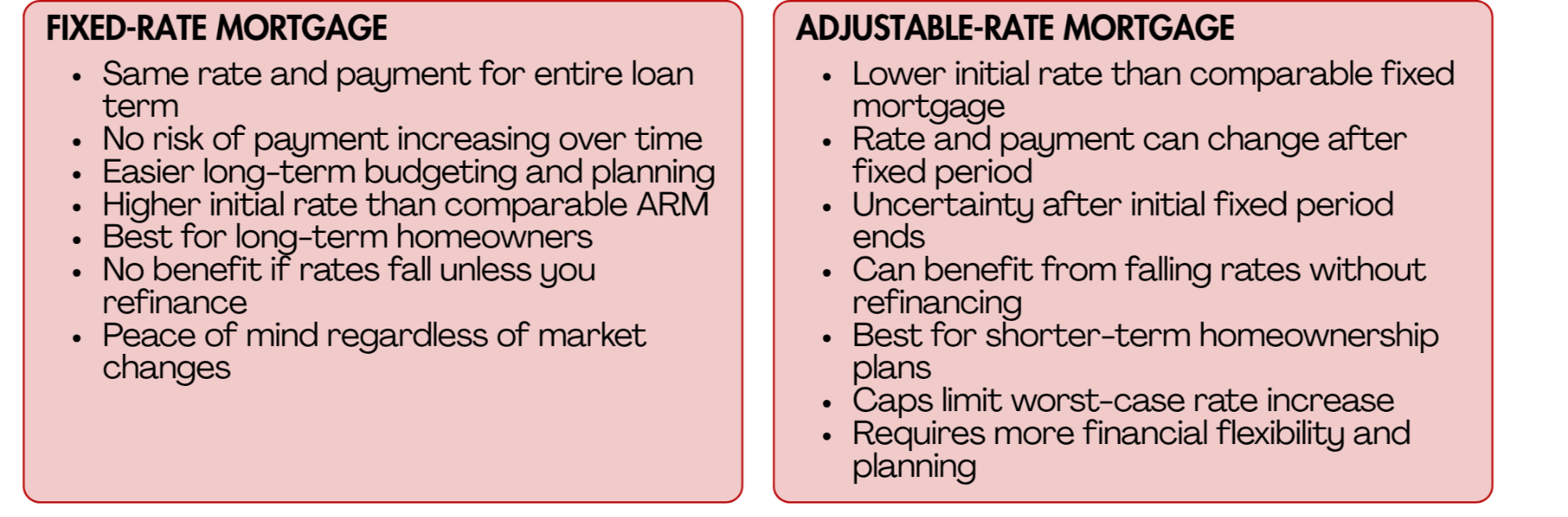
The real cost difference between fixed and ARM
During the initial fixed period of an ARM, borrowers consistently pay less in monthly interest than they would on a comparable fixed-rate mortgage because the ARM's starting rate is lower. That difference compounds over the months of the fixed period and can represent meaningful savings for buyers who know they will sell or refinance before the fixed period ends.
The question of which loan costs more over its full term depends entirely on what happens to interest rates after the ARM's fixed period concludes. If rates stay flat or fall, the ARM borrower continues to enjoy lower costs. If rates rise significantly, the ARM borrower's payments increase, potentially erasing the savings from the early years and then some. This interest rate uncertainty is the core risk that borrowers accept in exchange for the ARM's lower starting rate.

When a fixed-rate mortgage makes more sense
A fixed-rate mortgage is almost always the right choice when you plan to stay in the home for a long time, when you value payment predictability highly, when your budget has limited room to absorb a potential payment increase, or when the rate difference between available fixed and ARM products is relatively small.
- You plan to stay in the home long-term. The longer you hold the loan, the more valuable rate certainty becomes and the more likely the ARM's risk period will affect you.
- Interest rates are currently low historically. Locking in a low fixed rate when rates are already favorable protects you from paying more if rates rise in the future.
- Your budget is tight. If a significant payment increase after an ARM adjustment would create financial hardship, the certainty of a fixed payment is worth paying the premium for.
- You prefer simplicity and peace of mind. The fixed-rate mortgage asks nothing of you after closing except that you make the same payment every month. Some borrowers find that simplicity genuinely valuable.
When an adjustable-rate mortgage makes more sense
An ARM can be a genuinely smart financial choice in specific circumstances, and dismissing it entirely because of its variable nature misses situations where it delivers real and meaningful savings with manageable risk.
- You have a clear short-term ownership plan. If you know you will sell the home within five to seven years, a 5/1 or 7/1 ARM gives you a lower rate for that entire period with no adjustment risk affecting you at all.
- Rates are currently high and expected to fall. If you anticipate refinancing into a lower fixed rate within a few years, an ARM's lower starting rate keeps costs down in the interim without locking you into today's higher fixed rate long-term.
- You qualify for significantly more home with the ARM payment. In high-cost markets, the lower initial payment of an ARM sometimes enables a purchase that a fixed payment would not qualify for, and that can make a meaningful difference in the homes available to you.
- The rate spread is significant. When the difference between available ARM and fixed rates is substantial, the savings during the fixed period are large enough to justify the post-fixed period uncertainty for buyers with sufficient financial flexibility.
The risk of betting on refinancing
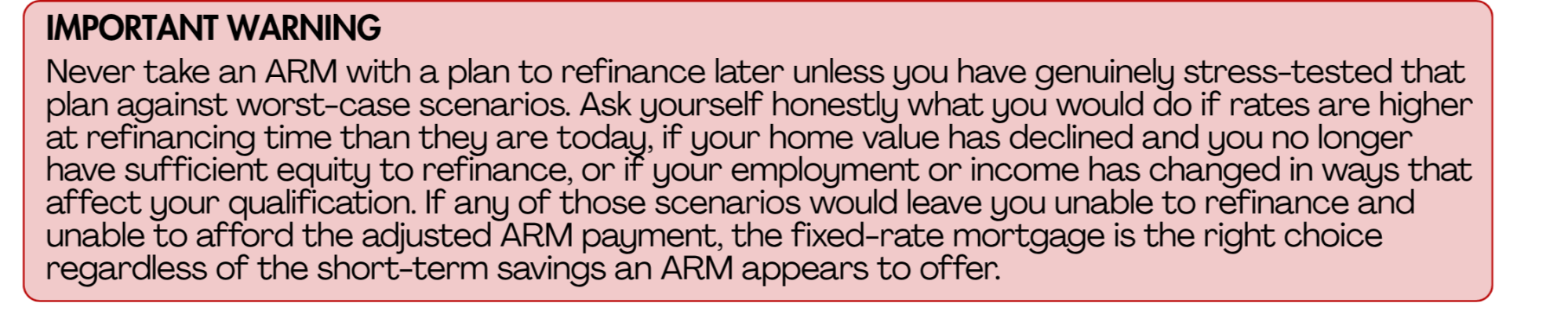
Many borrowers choose an ARM with the intention of refinancing into a fixed-rate mortgage before the fixed period ends, which is a sound strategy in theory but carries real risks in practice. Refinancing requires you to qualify for a new loan at whatever rates exist at the time of the refinance, and those rates may be higher than what you anticipated when you took out the ARM. Your financial situation must also still qualify you for refinancing, which is not guaranteed if your income, credit, or home equity has changed since you originally borrowed.
Fixed vs ARM in the current rate environment
The right choice between a fixed and adjustable rate mortgage is influenced by the current interest rate environment and where rates are expected to move over the coming years. When fixed rates are historically low, locking in makes obvious sense since there is limited room for rates to fall meaningfully further and significant potential for them to rise. When fixed rates are elevated, as they have been in recent years after a period of historic lows, the calculus becomes more nuanced.
In a higher rate environment, ARMs become more attractive relative to fixed loans because the spread between the two rates tends to widen, making the initial savings more significant. Buyers who believe rates will fall meaningfully within their planned ownership window may find the ARM's lower starting rate combined with a future refinancing opportunity genuinely compelling. Buyers who are uncertain about the rate outlook or their own timeline are generally better served by the certainty of a fixed rate, even if it costs more in the near term.
The bottom line
A fixed-rate mortgage offers complete payment predictability for the entire life of the loan at a rate that is typically higher than what an ARM would start at. An adjustable-rate mortgage offers a lower starting rate during an initial fixed period and then adjusts periodically based on market conditions, with caps that limit but do not eliminate the risk of payment increases. Fixed-rate mortgages are the right choice for most long-term homeowners who value stability and want to eliminate interest rate risk from their financial picture. ARMs can be the right choice for buyers with a clear and realistic short-term ownership plan, significant financial flexibility, or a well-reasoned expectation that rates will fall and a refinancing opportunity will present itself before the adjustment period creates any real risk. Understanding which category you actually fall into, rather than which one sounds better in the abstract, is the key to making the mortgage decision that genuinely serves your financial situation.
GET MORE INFORMATION
