
Blog > What Is Curb Appeal, and Why Does It Matter?

What curb appeal actually means
Curb appeal is the overall attractiveness of a home as seen from the street, specifically from the curb. It encompasses everything a buyer, appraiser, or passerby sees when they look at the exterior of a property, including the condition of the lawn and landscaping, the state of the driveway and walkways, the appearance of the exterior walls and roofline, the front door and entryway, the garage door, outdoor lighting, and any decorative elements that contribute to the visual character of the home from outside.
The term became common in real estate because the view from the curb is almost always the first view a buyer gets of a home, whether they are driving by out of curiosity, arriving for a scheduled showing, or scrolling through listing photos online. That first view creates an immediate emotional response that shapes how the buyer approaches everything that follows inside the home.
Why curb appeal matters so much
Buyers make judgments about homes extraordinarily quickly. Research on consumer behavior and real estate consistently shows that buyers form a strong opinion about a property within seconds of seeing the exterior, and that opinion is remarkably resistant to revision. A buyer who pulls up to a home with strong curb appeal arrives at the front door already inclined to like what they find inside. A buyer who arrives at a home with neglected landscaping, peeling paint, or a cracked driveway arrives already looking for reasons to be disappointed.
This psychological reality has direct financial consequences for sellers. Homes with strong curb appeal tend to attract more showing requests, receive offers more quickly, and sell closer to or above asking price compared to similar homes with neglected exteriors. The exterior is not just packaging. It is a signal about how the home has been maintained overall, and buyers read that signal whether they consciously intend to or not.

Curb appeal and listing photos
In the modern real estate market, curb appeal matters even before a buyer ever visits the property in person. The exterior photo is almost always the first listing image buyers see when browsing homes online, and it determines whether they click through to see the rest of the photos or keep scrolling to the next listing. A stunning interior with a weak exterior photo will generate fewer online clicks, fewer showing requests, and ultimately fewer offers than a well-presented home where the exterior photo draws people in immediately.
This online dimension of curb appeal has made the exterior appearance of a home even more important than it was in previous real estate eras, since the exterior photo now effectively serves as the home's digital storefront in a marketplace where buyers are making rapid decisions across dozens of listings at once.

1. Lawn and landscaping
The condition of the lawn and surrounding landscaping is the first thing most buyers notice from the street, and it has a disproportionate impact on overall curb appeal relative to its cost to address. A freshly mowed lawn with clean edges, trimmed shrubs, and well-maintained garden beds signals that the property is cared for. Overgrown grass, dead plants, and neglected garden beds signal the opposite.
You do not need a professionally designed landscape to have strong landscaping curb appeal. A clean, well-maintained version of whatever is already planted typically delivers most of the benefit. Mow and edge the lawn, trim any shrubs or hedges that have grown beyond their intended shape, remove dead plants and replace them with simple and inexpensive options from a local nursery, and add a fresh layer of mulch to garden beds to give the landscaping a finished and intentional appearance.
- Mow and edge the lawn. Clean edges along walkways and driveways make the entire yard look more intentional and well kept.
- Add fresh mulch to garden beds. A two-inch layer of fresh mulch makes existing plantings look significantly more polished for minimal cost.
- Plant seasonal color near the entry. A few potted plants or flowering annuals near the front door add warmth and welcome without a major investment.
- Trim trees and shrubs. Remove dead branches and shape overgrown shrubs so they complement rather than obscure the home's exterior.
2. Front door and entryway
The front door is the focal point of the entire exterior and the last thing a buyer looks at before stepping inside. Its condition, color, and hardware communicate something about the home's overall personality, and a well-chosen front door update can transform the curb appeal of an otherwise ordinary exterior without requiring any other changes.
Repainting the front door in a classic, welcoming color is one of the most frequently cited high-impact, low-cost curb appeal improvements available. Deep navy, forest green, charcoal, deep red, and classic black are colors that photograph well, age gracefully, and work across a wide range of home styles. Pair the fresh paint with updated door hardware including a new handle, lockset, and kickplate, and the entry will look noticeably more polished and cared-for than it did before.

3. Garage door
On homes where the garage faces the street, the garage door occupies a large percentage of the total exterior visual surface and has an enormous impact on overall curb appeal. A worn, dented, or visually dated garage door drags down the appearance of the entire facade, while a clean, well-maintained, or newly replaced door elevates it significantly.
Garage door replacement consistently ranks as one of the highest return exterior improvement projects in national cost versus value studies, often returning over 90 cents on every dollar spent in terms of sale price impact. For homes with a two-car or three-car garage facing the street, the visual impact of a new garage door is substantial enough to meaningfully change how buyers perceive the home from the moment they pull into the driveway. If full replacement is not in the budget, a thorough cleaning and a coat of fresh paint designed for garage doors is a reasonable alternative that improves the appearance at a fraction of the replacement cost.
4. Exterior paint and siding condition
Peeling, faded, or stained exterior paint is one of the most damaging curb appeal issues a home can have because it suggests broad neglect and raises questions about what else in the home has been left without attention. Fresh exterior paint or a thoroughly cleaned and power washed exterior surface addresses this perception immediately and signals that the property has been actively maintained.
For homes where the exterior paint is in decent condition but looking dull, a professional power wash can restore significant visual freshness without the cost of repainting. For homes where the paint is genuinely worn, faded, or peeling, repainting the exterior before listing is almost always worth the investment in markets where it is financially feasible relative to the home's value.
5. Driveway and walkways
Cracked, stained, or weed-filled concrete or pavers create a visual roughness that undermines an otherwise well-maintained exterior. Power washing the driveway and walkways to remove staining, oil spots, and biological growth is one of the simplest and most affordable curb appeal improvements available and can make a dramatic difference in how finished and cared-for the property looks overall.
For driveways with significant cracking or deterioration, sealing the concrete or applying a fresh layer of asphalt sealer on blacktop driveways is an affordable option that dramatically improves the appearance. Weeds growing through expansion joints or along edges should be removed and treated before any photos are taken or showings begin, since even small amounts of visible weed growth give the exterior a neglected appearance that is disproportionate to the actual effort required to address it.
6. Exterior lighting
Exterior lighting serves double duty in curb appeal. During daytime showings and listing photos, fixture style and condition contribute to the overall visual impression of the entryway and facade. During evening showings or twilight photography, which has become increasingly popular in real estate marketing, exterior lighting creates warmth, depth, and a welcoming atmosphere that daytime photos alone cannot capture.
Replacing outdated or mismatched porch lights with a coordinated set of modern fixtures is an affordable update that noticeably elevates the entryway. Adding solar-powered pathway lights along the walkway from the driveway to the front door adds warmth and definition to the approach at minimal cost and without any electrical work required.
7. Small details that add up
Beyond the major elements, a number of small details collectively contribute to the overall sense of care and quality that strong curb appeal communicates. These items cost very little individually but their cumulative effect on buyer perception is meaningful.
- Updated address numbers. Modern, clearly visible house numbers in a finish that coordinates with door hardware give the entry a finished, intentional look.
- Mailbox condition. A rusted, dented, or generic mailbox is a small detail that buyers notice subconsciously. A new or freshly painted mailbox that coordinates with the home's exterior is an easy and inexpensive update.
- Door mat and entry decor. A clean, simple door mat and a potted plant on either side of the entry creates a welcoming moment that buyers feel as they approach the door.
- Fence condition. A fence that is leaning, missing boards, or badly weathered needs attention before listing, since it is highly visible from the street and communicates maintenance habits immediately.
- Gutters and downspouts. Clogged, sagging, or rusted gutters are noticed during showings and flagged during inspections. Cleaning and reattaching any loose sections is a worthwhile presale task.
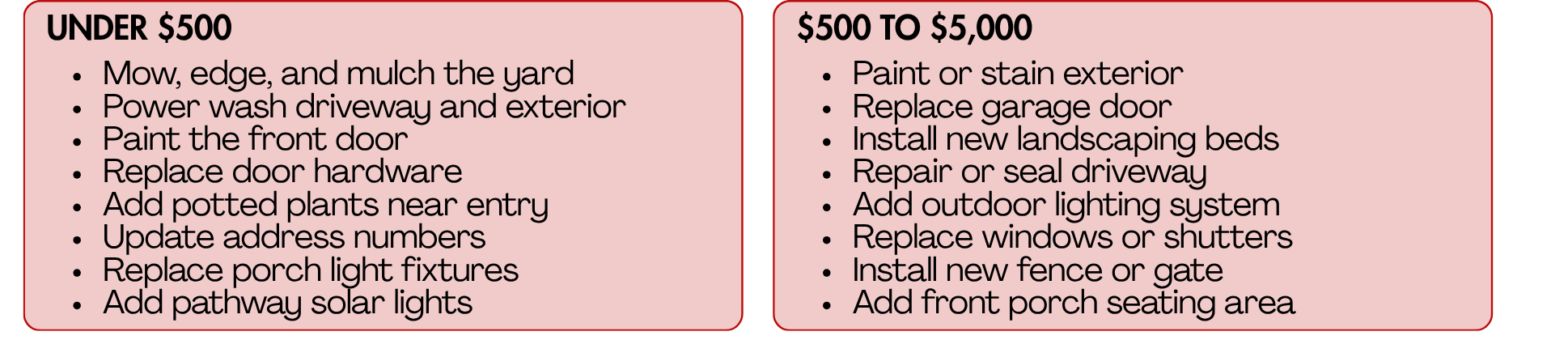
Curb appeal improvements by budget
Curb appeal ROI at a glance



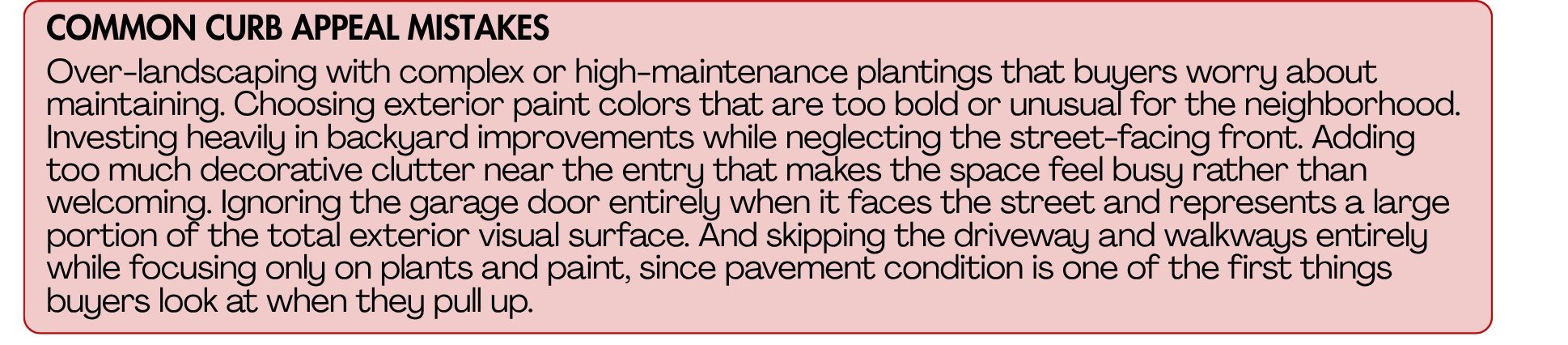
Curb appeal mistakes to avoid
Curb appeal in the Arizona desert
In Arizona markets including the Phoenix metro, East Valley communities, and Tucson, curb appeal takes on some specific characteristics that are different from what works in greener climates. Lush green grass lawns, while possible in Arizona, require significant water and maintenance that can actually work against a home's appeal in a market where buyers are increasingly aware of water costs and drought conditions.
Desert-appropriate landscaping done well, with clean gravel, well-spaced desert plants, and a clear and intentional design, can be just as visually compelling and significantly more marketable than a struggling green lawn in a desert climate. The key is that the landscaping looks intentional and maintained regardless of its style. A clean, well-raked gravel yard with healthy desert plants and defined borders reads as well-cared-for in an Arizona context, while the same yard with weeds, patchy gravel, and overgrown plants reads as neglected even though both are technically desert landscaping.
The bottom line
Curb appeal is the sum total of everything a buyer sees, feels, and experiences from the moment they first view a home from the street to the moment they step through the front door. It matters because buyers make rapid emotional judgments about properties that are very difficult to reverse once formed, because the exterior photo is now the digital storefront of every home in an online marketplace, and because the signal that a well-maintained exterior sends about the overall condition of the property carries real financial weight in the final offer price. The good news is that meaningful curb appeal improvements do not have to be expensive. Consistent maintenance, fresh landscaping, a painted front door, a clean driveway, and updated lighting can collectively transform how a home is perceived for a few hundred dollars and a weekend of effort, and the return on that investment shows up directly in how quickly the home sells and what buyers are willing to pay for it.
GET MORE INFORMATION
