
Blog > More Homes for Sale, Fewer Buyers. So Why Are Some Homes Still Selling So Quickly?
More Homes for Sale, Fewer Buyers. So Why Are Some Homes Still Selling So Quickly?
by

Phoenix has roughly twice as many home sellers as buyers, fewer homes are going under contract, and buyers have more negotiating power than they've had in years.
Sounds alarming, right?
But here's what the headlines aren't telling you: Home prices are holding steady, and we're still seeing homes sell in days—even around the $1 million price point.
So what's really happening?
We're not seeing the signs of an imminent housing crash. We're seeing a market where buyers have become more selective, sellers face more competition, and pricing and strategy matter more than ever.
Let's look at what the numbers actually tell us—and what we're experiencing firsthand with our buyers and sellers.
1. Home Prices Are Holding Steady, but the Market Is Slowing
Despite everything you may be hearing, the median home sales price across the Phoenix area remains at $450,000, exactly where it was one year ago.
Here's a look at September's numbers:
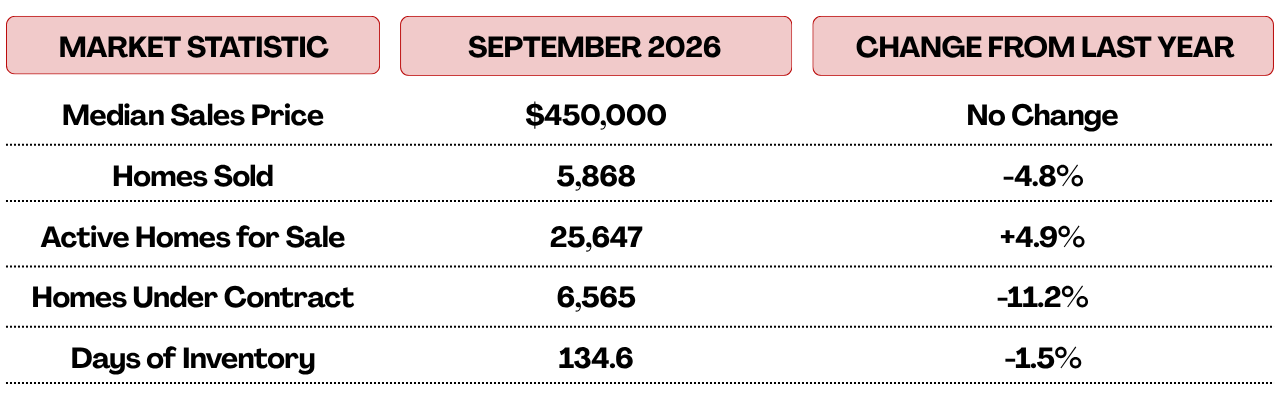
Source: Cromford Report, October 4, 2026.
The biggest concern isn't necessarily home prices. It's the declining number of buyers actively purchasing homes.
During September, the number of homes available for sale increased 8.3%, while the number of homes under contract fell 10.2%.
That means more homes are competing for fewer buyers.
However, declining sales activity doesn't automatically mean declining home values. It means sellers need to pay closer attention to the competition.
2. There Are Roughly Two Sellers for Every Buyer in Phoenix
According to Redfin, the Phoenix metropolitan area had approximately 106% more home sellers than buyers in September.
Put simply, there are roughly two sellers competing for every buyer.
That is a major shift from 2020 and 2021, when buyers were frequently competing against multiple offers, waiving inspections, and paying above asking price.
Today, buyers have more choices and more negotiating power.
But I think there's an important disconnect in how some buyers and sellers are interpreting this market.
Some sellers are still thinking it's 2020, while some buyers are expecting 2009. Neither is an accurate picture of today's market.
Sellers can't simply name their price and expect buyers to line up. But buyers shouldn't assume that every seller is desperate or willing to accept an offer 40% or 50% below asking price.
Most sellers aren't in that position, and the numbers don't suggest widespread desperation.
Instead, we're seeing a market where buyers and sellers have to work a little harder to find common ground.
3. Why Some Homes Sell Immediately While Others Sit for Months
This is where I want to share some of what we're experiencing firsthand.
Over the past several months, my team and I have handled three home sales in Gilbert, each around the $1 million price point.
All three homes sold either before officially hitting the market or within approximately one week of being listed.
That's happening in the same market where we're hearing about homes sitting for months and sellers struggling to find buyers.
So what's the difference?
In my experience, it comes down to understanding the competition, properly positioning the property, and creating a strong first impression.
A home doesn't need to be the least expensive property in the neighborhood to sell quickly. But buyers need to recognize its value compared with the other homes they can purchase.
And that brings me to a recent experience that I think illustrates just how important pricing can be.
A Real Example: The Cost of Missing the Market
About five months ago, a homeowner in Gilbert contacted me about selling their property.
After reviewing the home and the market, I explained that I believed the maximum realistic selling price was approximately $560,000.
The seller ultimately chose another agent who believed the home could sell for considerably more.
Unfortunately, the home didn't sell.
Over the following months, the property remained on the market, went through price reductions, and was eventually listed with another agent at $535,000.
The seller ultimately decided to make another change and hired us.
Today, we have the property under contract for $515,000.
I'm not sharing this story to criticize anyone. And I can't say with certainty what the home would have sold for five months ago.
But based on my experience and the market conditions at the time, I firmly believe the seller had an opportunity to sell much sooner and potentially for considerably more money.
The difference between my original $560,000 estimate and the current contract price is $45,000.
That doesn't mean the home would have sold for exactly $560,000. But it demonstrates how costly an unsuccessful listing can become when a property spends months chasing the market.
You only get one chance to make a first impression.
When a home first hits the market, it's new. Buyers who have been watching the neighborhood notice it. Agents share it with their clients. It has an opportunity to stand out.
But when a home is overpriced, buyers may simply move on to something they believe offers better value.
As the weeks and months pass, the listing loses some of that initial excitement. Price reductions may eventually attract buyers, but by then the market may have changed, and buyers may wonder why the property hasn't sold.
One of the biggest mistakes I'm seeing right now is sellers trying to set the pace of the market rather than responding to what the market is telling them.
Beautiful, unique, well-presented homes that are priced correctly can still perform exceptionally well.
The challenge is that many homes look very similar to the properties around them, yet sellers are asking premium prices without offering buyers a clear reason to pay more.
If your home looks like the one next door, buyers need a compelling reason to choose yours.
That's where accurate pricing, preparation, presentation, and marketing become so important.
4. What Does a Good Deal Actually Look Like for Buyers Today?
There's no question that buyers have more opportunities today than they did several years ago.
But I think we need to be realistic about what a good deal actually means.
From the transactions and negotiations we're seeing, buyers are often finding value in ways that go beyond simply getting a large discount off the asking price.
For example, we're seeing sellers agree to:
- Pay buyer closing costs: Helping buyers reduce the amount of cash they need at closing.
- Buy down mortgage interest rates: Contributing money to help buyers secure a lower interest rate and potentially reduce their monthly payment.
- Make substantial repairs: Including roofs, air-conditioning systems, and other major items that sellers might have been less willing to address in stronger markets.
- Provide home warranties: Giving buyers additional protection against certain unexpected repair expenses.
- Negotiate purchase prices: Particularly when homes have been on the market longer or sellers have a specific reason to move.
These concessions can add up to thousands or even tens of thousands of dollars in value, depending on the transaction.
For example, on a $450,000 home, a seller contributing $10,000 toward a buyer's closing costs or mortgage rate buydown may provide more immediate financial benefit than a modest reduction in the sales price.
The important thing is to look at the entire transaction, not just the purchase price.
A motivated seller isn't necessarily a desperate seller.
And a good deal isn't always about how much you can get someone to reduce their asking price. It's about the total value you're receiving and whether the home makes financial sense for you.
5. Mortgage Rates: Should Buyers Keep Waiting?
Mortgage rates continue to be one of the biggest challenges facing the housing market.
According to the Cromford Report, the average 30-year fixed mortgage rate reached approximately 7.61% on October 5 before improving to around 7.33% on October 15.
That's still considerably higher than the historically low rates buyers enjoyed during 2020 and 2021.
But here's something I think is important to understand.
There's no reliable evidence that mortgage rates are headed back to 3% or 4% anytime soon.
Those unusually low rates were influenced by extraordinary economic conditions and Federal Reserve policies during the pandemic.
Mortgage rates can certainly decline, and even a modest improvement can make a meaningful difference in monthly payments.
However, planning your entire home purchase around the expectation that rates will return to historic lows may mean waiting for something that never happens.
I encourage buyers to focus on what they can afford today.
If a home fits your needs, the monthly payment is comfortable, and you plan to own it for several years, today's market may offer opportunities that weren't available when rates were lower and competition was much stronger.
If rates improve later, refinancing may become an option, although it's never guaranteed.
And if the payment doesn't make sense today, waiting may be the right decision.
6. Your City Matters, but Your Neighborhood Matters Even More
One of the tools I follow closely is the Cromford Market Index (CMI).
The CMI measures the balance between housing supply and buyer demand in different cities across the Phoenix area.
Think of it like a scoreboard showing whether buyers or sellers have the advantage.
- Above 110: Seller's market
- 90–110: Balanced market
- Below 90: Buyer's market
The higher the number, the stronger the market generally is for sellers. The lower the number, the more negotiating power buyers tend to have.
Here's where several local cities stood on October 15:
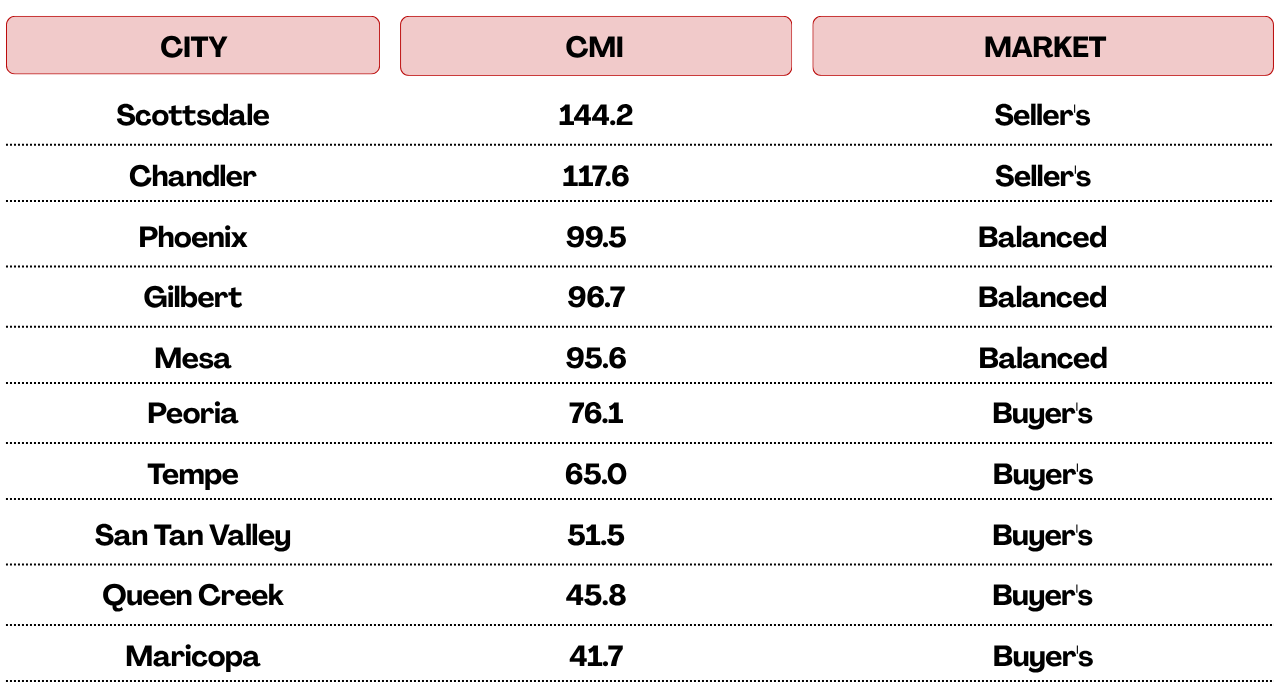
Source: Cromford Report, October 15, 2026.
Every one of the 18 cities tracked by Cromford saw its index decline over the previous month, meaning conditions shifted further in buyers' favor.
But here's something I want to emphasize.
Even within these cities, individual neighborhoods can perform very differently.
A desirable neighborhood with limited homes for sale may still experience strong buyer demand, even when the overall city is considered a buyer's market.
The same is true for certain property types, price ranges, and homes with features that are difficult to find.
A well-priced home with a great floor plan, updated finishes, a desirable lot, or unique amenities may attract significantly more interest than other homes in the same area.
That's why citywide averages should be used as a starting point, not the final answer when determining a home's value.
7. Is Another Housing Crash Coming?
With headlines about record buyer leverage and declining demand, it's understandable that some people are concerned about another housing crash.
But I think it's important to separate what we're actually seeing from what people fear might happen.
Yes, buyer demand has weakened.
Yes, more homes are available for sale.
And yes, some sellers may need to reduce their prices, particularly those who purchased near the top of the market or need to sell quickly.
But that doesn't automatically mean we're heading toward another 2008-style housing crisis.
According to the Cromford Report, approximately 94.6% of homes currently under contract are normal sales, rather than foreclosures or pre-foreclosures.
Distressed properties have been increasing, but they still represent a relatively small portion of the market.
Many homeowners who purchased before the rapid price increases of recent years also have substantial equity in their homes.
That gives them options.
They may be able to wait for better market conditions, negotiate with buyers, or simply decide not to sell.
That doesn't eliminate the possibility of further price declines, and we should continue monitoring buyer demand and distressed sales.
But the data we're seeing today is much more consistent with a market adjusting to affordability challenges than a market experiencing widespread financial distress.
8. What I Would Tell Buyers and Sellers Right Now
If you're buying: You have opportunities that didn't exist a few years ago. Take advantage of the increased selection and negotiating power, but don't confuse a buyer's market with a market where every seller is desperate. Focus on the home's value, your monthly payment, and the overall terms of the transaction.
If you're selling: Homes are still selling, including homes at higher price points. But buyers are more selective, and the competition is real. Your first impression matters. Pricing correctly from the beginning, preparing your home properly, and understanding the competing listings may make the difference between selling quickly and spending months on the market.
My Perspective
After more than a decade helping people buy and sell homes throughout the Phoenix area, one thing I've learned is that the headlines rarely tell the complete story.
I don't believe today's market is as bad as some headlines make it sound. But I also don't believe sellers can ignore what's happening around them.
The market is sending a clear message: buyers are more cautious, affordability matters, and homes need to offer compelling value.
We're still seeing homes sell quickly and successfully when they're positioned correctly. We're also seeing homes sit for months when sellers are unwilling to adjust to the market.
The biggest disconnect today may be that some sellers still believe it's 2020, while some buyers believe it's 2009. The reality is somewhere in between.
Whether you're considering buying, selling, or simply trying to understand your home's value, I encourage you to look beyond the headlines and focus on what's actually happening in your specific neighborhood.
Because in real estate, the right information and the right strategy can make a substantial difference.

Gordon Hageman
Associate Broker | Arizona One Real Estate Team
Brokered by REAL Broker
480-498-3334
Sources: The Cromford Report (October 4 and October 16, 2026); Redfin (October 14, 2026). Statistics represent the reporting periods and geographic areas covered by each source. Mortgage rates vary by lender, borrower qualifications, loan type, and market conditions.
If your home is currently listed with another real estate brokerage, this information is not intended as a solicitation of that listing.
GET MORE INFORMATION
