
Blog > Is the Phoenix Housing Market Becoming Normal Again?

If the housing market has felt anything but normal over the last six years, you're probably not alone.
Think about everything we've experienced in such a short period of time: rapidly rising home prices, historically low mortgage rates, bidding wars, homes selling almost immediately, followed by one of the fastest increases in mortgage rates in decades and a major slowdown in the market.
That's a lot of change packed into just six years.
But I think what we're finally starting to feel now is something much less exciting—and that's not necessarily a bad thing.
A more normal real estate market.
That doesn't mean home prices won't go up or down. They will. But instead of the huge spikes and declines that tend to dominate the headlines, we may be moving toward a market where smaller ups and downs are simply part of normal real estate.
Think about 2008 and 2020–2022. They were two completely different real estate markets, but they had one important thing in common:
They were extreme.
When you look at the much bigger history of real estate, those extreme markets are relatively short periods of time.
Most real estate markets aren't exciting enough to make headlines.
And maybe that's a good thing.
Here's what I'm watching right now—and more importantly, what it could mean for you.
Who Has the Advantage Right Now?
Phoenix-area home prices are 0.88% lower than a year ago, but that Valley-wide number doesn't tell you what's happening in your city.
WHO HAS THE ADVANTAGE?
🟩 SELLER ADVANTAGE
Scottsdale — 153.5
Chandler — 139.5
Mesa — 117.8
Gilbert — 110.4
Chandler — 139.5
Mesa — 117.8
Gilbert — 110.4
🟨 BALANCED
Tempe — 91.3
🟢 BUYER ADVANTAGE
San Tan Valley — 57.1
Maricopa — 54.0
Queen Creek — 52.1
Buckeye — 51.0
Maricopa — 54.0
Queen Creek — 52.1
Buckeye — 51.0
Higher numbers mean more leverage for sellers. Around 90–110 is considered balanced. Lower numbers mean more leverage for buyers.
What does this mean for you?
If you're buying in Queen Creek, your negotiating strategy should probably look very different from someone buying in Chandler.
And if you're selling, a headline about the overall "Phoenix housing market" doesn't tell you what your home is worth.
Your neighborhood, competition, condition and price matter much more.
Buyers Haven't Disappeared. They're More Selective.
Just this week, we received a full-price offer on a $975,000 Gilbert home before it even officially went on the market.
At the same time, I have another real-world example that shows the other side of today's market.
About three months ago, a homeowner contacted me about selling her home. After reviewing the home, neighborhood and current market, I told her $560,000 was the highest price I felt we could reasonably start at.
She ultimately chose another agent, and the home was listed for $599,000.
Today, that home is still on the market and has been reduced to $530,000.
Here's the frustrating part: it's a good home in a great neighborhood. Had it been priced appropriately from the beginning, I believe it likely would have sold for more than its current $530,000 asking price.
Those two homes tell an important story about today's market.
One received a full-price $975,000 offer before hitting the market.
The other started at $599,000 and has been reduced to $530,000 without selling.
Buyers haven't disappeared. They're paying attention to value.
What I've consistently seen is pretty simple:
Good home + good condition + realistic price = buyers are still buying.
This is also why we need to be careful with headlines about price reductions.
If a home is realistically worth $600,000, gets listed for $650,000 and eventually gets reduced to $600,000, did the home's value really fall $50,000?
Not necessarily. The seller may have simply started $50,000 too high.
Starting too high can actually cost a seller money. The home sits, buyers begin wondering what's wrong with it, and eventually the seller has to compete with newer listings while reducing the price.
For sellers: The highest suggested listing price isn't necessarily the advice that will put the most money in your pocket.
For buyers: A large price reduction doesn't automatically mean you're getting a bargain.
Don't Forget: Arizona Real Estate Is Seasonal
August and September are historically slower months for Greater Phoenix real estate.
It's hot, school is starting, and fewer people are excited about spending their Saturday afternoon touring houses when it's 110° outside.
So when we see activity slow during this time of year, it doesn't automatically mean the housing market is getting worse.
There's another side to Arizona's seasonality.
As temperatures begin cooling, our winter visitors start returning and another pool of potential buyers enters the market. Many of those buyers are particularly interested in single-level homes.
So if you own a single-level home—especially one that is easy to maintain—the buyer pool for your property could look different as we move into the cooler months.
The takeaway: Don't judge the direction of the housing market based on one slow summer month. Sometimes the market isn't changing direction. It's simply following its normal seasonal pattern.
Are Foreclosures Coming Back?
This is something I'm watching, but it's also an area where headlines can easily create unnecessary fear.
Locally, about 3.9% of homes under contract are in pre-foreclosure, while another 1.5% are bank-owned.Financial distress has increased recently.
FORECLOSURES & BANKRUPTCIES: THE BIGGER PICTURE
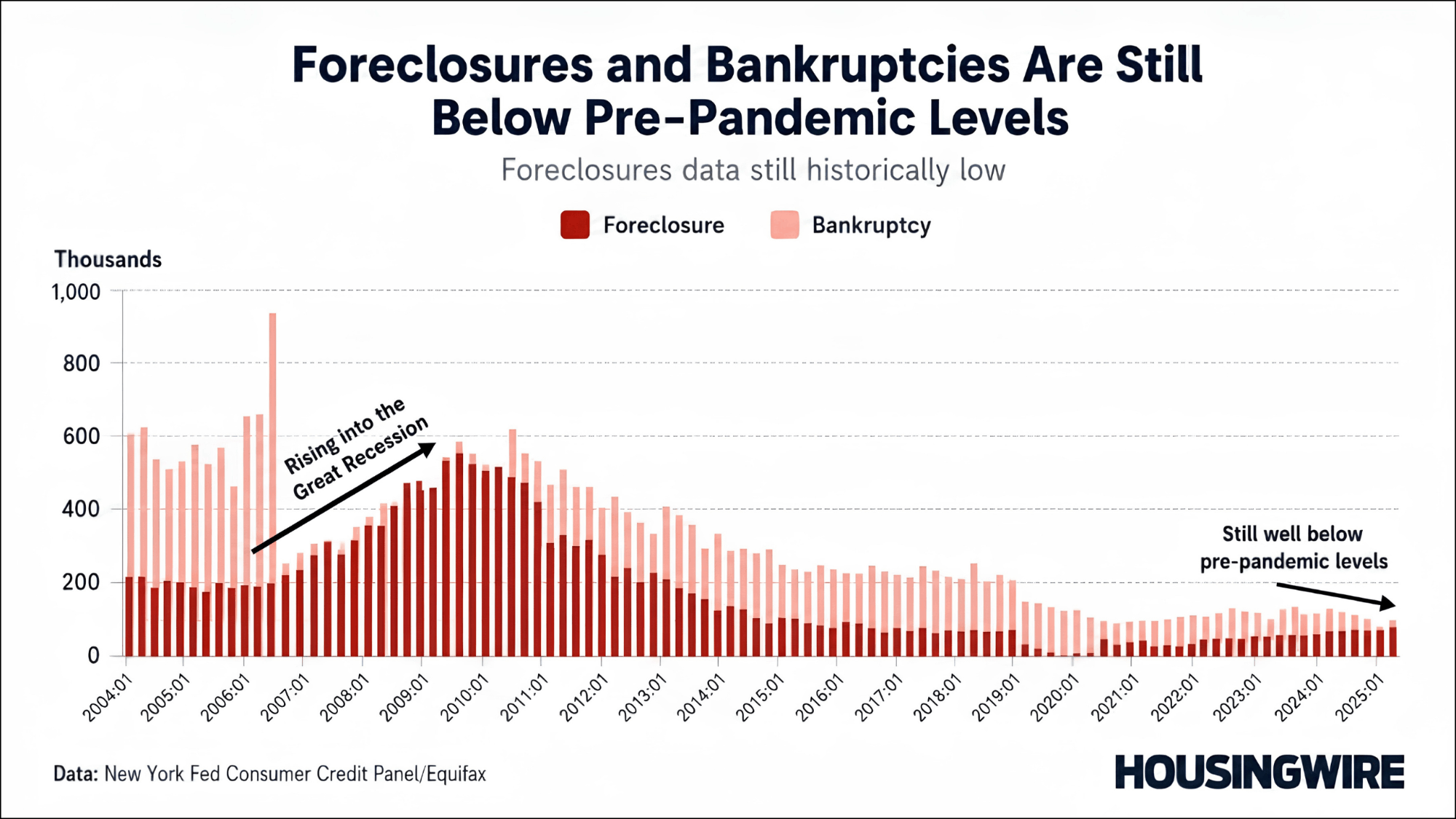
Here's the word I think is missing from a lot of the conversation:
NORMAL.
Foreclosures and pre-foreclosures are a normal part of every real estate market.
When the market is good, there are foreclosures.
When the market is bad, there are foreclosures.
People experience job losses, divorces, unexpected expenses and other life changes regardless of what home prices are doing.
What matters is how many we're seeing and how today's numbers compare with history.
That's also why percentages can sometimes be misleading.
If something increases from 1 to 2, that's a 100% increase. That sounds enormous—but we're still only talking about 2.
And when we zoom out and look at the bigger picture:
Pre-foreclosures and foreclosures remain historically low.
Look at the enormous spike surrounding the Great Recession compared with where we are today.
Yes, financial distress has increased enough that I'm watching it. But an increase from historically low levels is very different from a foreclosure crisis.
My take: Yellow light, not red light.
Worth watching? Absolutely.
Evidence we're heading into another 2008? Not based on the numbers we're seeing today.
Many homeowners entering pre-foreclosure are also able to sell before the lender takes ownership, which helps explain why bank-owned homes remain relatively uncommon.
This is another good example of Data Over Drama: percentages can make a great headline, but historical context helps us make better decisions.
Maybe “Boring” Is Actually Good
Here's one final piece of perspective on home prices.
The Valley-wide median sale price is currently about $449,900, with a mid-September forecast of approximately $448,000.
A quick explanation because this number can be misleading:
Median doesn't mean the average Valley home is worth $449,900. It simply means half of the homes sold for more and half sold for less.
Your home could be worth significantly more—or less—depending on its neighborhood, size, condition and features.
What's more interesting to me is the direction of the market.
We started 2026 with stronger momentum. As mortgage rates increased somewhat, that momentum flattened. Now we're also dealing with the normal late-summer slowdown we typically see around August and September.
As temperatures cool and our seasonal buyer population begins returning, there's an opportunity for the market to finish the year stronger than it looks today.
And here's where some longer-term perspective helps.
Before the unusual market that began in 2020, seeing home values appreciate roughly 3–5% in a year was much closer to what we thought of as normal, although it always varied by the home and neighborhood.
Then came 2020–2022.
We saw double-digit gains that simply weren't normal or sustainable. That was followed by a correction beginning in the second half of 2022, with weakness continuing into portions of 2023.
Since then, we've seen prices begin to stabilize and, depending on the area and type of home, start ticking upward again.
So when today's Valley-wide median forecast moves from $449,900 to $448,000, I don't see that as particularly dramatic.
It's pretty boring. And maybe that's a good thing.
A more normal real estate market doesn't need double-digit appreciation every year.
Prices can rise a few percent, flatten out, occasionally decline and then start moving again.
That's normal.
The extreme markets surrounding 2008 and 2020–2022 stick in our minds because they're memorable.
But they're the exceptions—not what we should expect every few years.
Data Over Drama
My biggest advice right now is simple:
Don't try to predict the next boom or crash—and don't make one of your biggest financial decisions based on a headline.
Headlines are designed to get our attention. Unfortunately, sometimes they do more to scare us than inform us.
Instead, look at what the actual numbers say about your situation.
If you're considering buying, we can look at the entire picture—your budget, monthly payment, available homes, negotiating opportunities, how long you expect to stay and whether buying actually makes financial sense for you.
If you're considering selling, we can look at your home's realistic value, your equity, selling costs, competition, expected proceeds and what your next move would look like before you make a decision.
Sometimes the numbers will say:
“This makes sense.”
Other times they may say:
“You're probably better off waiting.”
Either answer is valuable.
Too many people make assumptions about what they can do, can't do or should do without ever sitting down, looking at good data and putting together a real plan.
A good real estate decision should start with a plan—not a headline.
If a move has been on your mind, reply to this email or call/text me.
I'm happy to sit down with you, go through the numbers and put together a comprehensive plan showing what buying or selling would actually look like for you financially.
You don't need to be ready to move. You just need to be ready to get the facts.
Then you can decide whether buying, selling—or doing absolutely nothing right now—is the decision that makes the most sense for you.
GET MORE INFORMATION
