
Blog > How Do Real Estate Agents Determine a Home's Value?

One of the most common questions sellers ask before listing is how an agent arrives at the price they recommend. One of the most common questions buyers ask before making an offer is whether the asking price reflects what the home is actually worth. Both questions point to the same fundamental need: understanding how real estate professionals determine the value of a specific property in a specific market at a specific point in time. The process is more rigorous and more nuanced than most people realize, and understanding it helps both buyers and sellers make better decisions at every stage of a transaction.
1. The comparative market analysis: the foundation of every valuation
The primary tool agents use to determine a home's value is the comparative market analysis, commonly called a CMA. A CMA is a detailed analysis of recently sold homes that are similar to the subject property in terms of size, location, age, condition, and features. The logic behind it is straightforward: the best evidence of what a buyer will pay for a specific home is what buyers have actually paid for similar homes in the same area recently.
Unlike an appraisal, which is conducted by a licensed independent appraiser and follows a standardized methodology required by lenders, a CMA is prepared by a real estate agent and is typically offered to sellers at no cost as part of the listing consultation. While a CMA and an appraisal use similar principles and often reach similar conclusions, the CMA is a professional opinion rather than a certified valuation, and its accuracy depends heavily on the skill and local knowledge of the agent preparing it.

2. Selecting the right comparable sales
The quality of a CMA depends entirely on the quality of the comparable sales used to build it. Selecting comps is one of the most skill-dependent parts of the entire valuation process, and it is where the expertise of an experienced local agent diverges most significantly from what an automated online tool can produce.
A strong comparable sale shares as many characteristics as possible with the subject property. Location is the first filter, with agents generally looking for sales within the same neighborhood, subdivision, or school zone before expanding outward. Size is the second, with most agents trying to stay within 10% to 15% of the subject property's square footage. Age, bedroom and bathroom count, garage configuration, pool presence, lot size, and overall condition all factor into whether a particular sale is truly comparable or merely similar in one or two respects.
- Same neighborhood or subdivision. The closer the geographic match, the more reliable the comparison, since neighborhood-level demand can vary significantly even within the same ZIP code.
- Similar square footage. Generally within 10% to 15% of the subject property's total living area.
- Same bedroom and bathroom configuration. A three-bedroom two-bathroom home is typically compared to other three-two homes rather than four-bedroom properties.
- Sold within the past 90 days. In fast-moving markets, agents may narrow this to the past 30 to 60 days to reflect current conditions accurately.
- Similar age and condition. A newly renovated home compared to one that has not been updated in twenty years will require meaningful adjustments to produce a reliable value estimate.
3. Adjusting for differences between the subject and the comps
No two homes are identical, which means raw comp prices almost never transfer directly to the subject property without adjustment. The adjustment process is where the analysis moves from data retrieval to professional judgment, and it is the step that separates a carefully prepared CMA from a superficial one that simply averages nearby sale prices without accounting for meaningful differences between properties.
When a comparable sale has a feature the subject property lacks, the agent adjusts the comp's price downward to reflect what it would have sold for without that feature. When the subject property has a feature the comp lacks, the agent adjusts the comp's price upward to estimate what the comp would have sold for if it had that feature. The net result of all adjustments applied to each comp produces an adjusted sale price that represents a more accurate market value estimate for the subject property.



4. Evaluating active listings and pending sales
Sold comparable sales tell an agent what buyers have actually paid for similar homes, which is the most reliable evidence of value. But a complete valuation also looks at two additional categories of market data: active listings and pending sales.
Active listings are the current competition. They show what other sellers are currently asking for similar homes and give a buyer's perspective on the choices available in the market right now. If several comparable homes are actively listed at prices below the subject property's estimated value, those listings create competitive pressure that may require the seller to price more aggressively. If similar homes are listed above the estimated value, that suggests the market may support a higher price point than sold comps alone would indicate.
Pending sales are homes under contract that have not yet closed. They represent the very most current evidence of what buyers are willing to pay right now, before that agreement has been recorded as a closed sale. Agents who have relationships in the local market sometimes have insight into pending sale prices before they become public, which can meaningfully improve the accuracy of a current market analysis in a fast-moving environment.

5. Physical walkthrough of the property
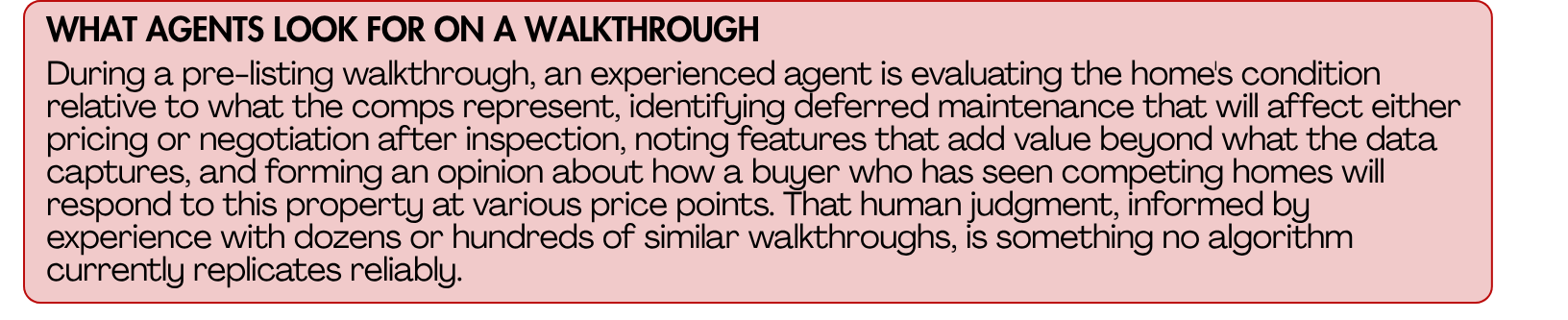
A CMA built entirely from MLS data without a physical visit to the property is inherently less accurate than one prepared after the agent has walked through and evaluated the home in person. Condition, quality of finishes, functional layout, natural light, noise levels, and a host of other factors that affect buyer perception and willingness to pay cannot be fully assessed from listing data and tax records alone.
When an agent physically walks through a home, they are calibrating the data-driven analysis against the visceral reality of what a buyer will experience during a showing. A home that looks equivalent on paper to a recent sale but smells of pet odor, has a cramped and poorly designed kitchen, or backs directly to a busy road will not achieve the same price as that comp regardless of what the numbers suggest. Conversely, a home with exceptional finishes, a beautifully designed outdoor space, or a particularly appealing view may justify pricing above what a simple data analysis would recommend.
6. Reading current market conditions
The same home priced in a seller's market where inventory is low and buyers are competing will support a significantly different price than the same home priced in a buyer's market where choices are plentiful and sellers are competing for a smaller pool of active buyers. Experienced agents incorporate the current state of the local market into their valuation in ways that go beyond what the historical comp data alone reflects.
Key market condition indicators agents monitor include the current months of supply, which tells them how quickly homes are moving relative to what is available, average days on market for homes in the price range, the percentage of listings selling above versus below asking price, and the trend direction of all of these metrics over the past sixty to ninety days. A market that was balanced three months ago but has tightened significantly since then warrants a more aggressive pricing recommendation than the closed comp data alone would suggest.


7. Applying local knowledge that data alone cannot capture
This is where the expertise of a genuinely experienced local agent diverges most significantly from a basic data analysis. Some factors that affect a home's value are not captured in MLS records, tax assessments, or any database that an automated tool can access. They exist in the accumulated knowledge of professionals who have worked a specific market intensively for years.
An agent who has been actively selling in a specific Gilbert or Chandler neighborhood for a decade knows which streets command a consistent premium because they offer quieter traffic, backing to a preserve, or proximity to a particularly desirable park. They know which subdivisions have HOA management issues that suppress prices relative to neighboring communities with similar homes. They know which school boundary changes have affected demand in specific streets. They know which new development projects are coming that have not yet affected recorded sale prices but are already influencing buyer sentiment in the market.
A real-world CMA example




Why online home value estimates often miss the mark
Automated valuation tools that generate instant home value estimates work by applying algorithms to publicly available data, primarily tax records and recorded sale prices. They are useful for a rough ballpark and for tracking broad trends, but they consistently struggle with accuracy in situations that require the kind of nuanced judgment that experienced local agents apply as a matter of course.
These tools cannot see inside the home. They cannot account for the quality of finishes, the functional design of the layout, the condition of systems and major components, or the unique features that make one property significantly more or less appealing than a statistically similar home next door. They also struggle in markets with limited recent sales where comparable data is sparse, in neighborhoods where homes vary significantly from one another, and in rapidly shifting market conditions where historical data is less predictive of current values.
The bottom line
Real estate agents determine a home's value through a methodical process that combines recent comparable sales carefully selected and adjusted for differences, an evaluation of active listings and pending sales, a physical walkthrough of the property, a read of current market conditions, and the application of local knowledge that no database fully captures. The result is a professional opinion of value that, when prepared by a skilled and experienced local agent, consistently outperforms automated tools in accuracy and usefulness for the real decisions that buyers and sellers need to make. Understanding how this process works gives both parties a clearer picture of where the recommended price comes from and why following it tends to produce better outcomes than the alternatives.
GET MORE INFORMATION
