
Blog > How Do I Choose the Right Neighborhood?

1. Start by defining what matters most to your life
The right neighborhood for one buyer is completely wrong for another, and the process of choosing well starts with being honest about what your daily life actually looks like and what you genuinely need from the area around your home. A retired couple looking for quiet and low maintenance has different neighborhood priorities than a young family with three children in school or a single professional who values walkability and proximity to nightlife and dining.
Before you start browsing listings or touring homes, write down what your ideal neighborhood looks like in practical terms. How far are you willing to commute to work on a daily basis? Do you need to be in a specific school district? How important is walkability to restaurants, parks, or shops? Do you prefer a dense urban feel or a quiet suburban one? Do you have pets that need outdoor access? Are you planning to start or grow a family in the next few years? The answers to these questions should drive your neighborhood search before anything else does.
2. Research school districts even if you don't have kids
School district quality is one of the most consistent and measurable drivers of home values in any real estate market. Homes in top-rated school districts command price premiums, sell faster, and hold their value better during market downturns than comparable homes in weaker districts. This relationship between school quality and home value is well documented and holds true even when the buyer purchasing the home has no children and no intention of ever using the local schools.
The reason is resale. When you eventually sell, a significant portion of your buyer pool will include families with children for whom school district quality is a primary decision factor. Buying in a strong school district expands the pool of future buyers who will want your home, which directly supports your ability to sell at a strong price when the time comes.

3. Evaluate safety and crime rates with real data
Safety is a universal priority for home buyers, but evaluating it requires going beyond general impressions and driving through a neighborhood once during a sunny Saturday afternoon. Crime statistics vary significantly not just by city or zip code but by specific neighborhood, and some streets that feel safe based on appearances have surprisingly active crime histories while others that feel less polished are genuinely low-crime areas.
Most local police departments publish crime data online broken down by area or reporting district, and tools that aggregate and map this data at the address or street level make it possible to research specific neighborhoods with reasonable accuracy. Look at trends over time, not just a single snapshot, since a neighborhood with improving crime statistics over several years tells a very different story than one where the numbers are moving in the wrong direction.

4. Test the actual commute, not just the map distance
Map distance and actual commute time are two completely different numbers in most metropolitan areas, and buyers who rely on map distance alone when evaluating neighborhood location consistently underestimate how much daily commute time affects quality of life. A neighborhood that is 20 miles from your workplace might involve a 25-minute drive at 7 am on a Tuesday or a 55-minute crawl depending on the specific route, traffic patterns, and time of day you actually travel.
Before committing to a neighborhood, drive the actual route between the home and your workplace during your actual commute time on a typical workday. Do this in both directions if your commute involves different routes in the morning and evening. If you rely on public transit, walk through the transit journey in real time to understand what it actually involves rather than what the route planner suggests it should take in ideal conditions.

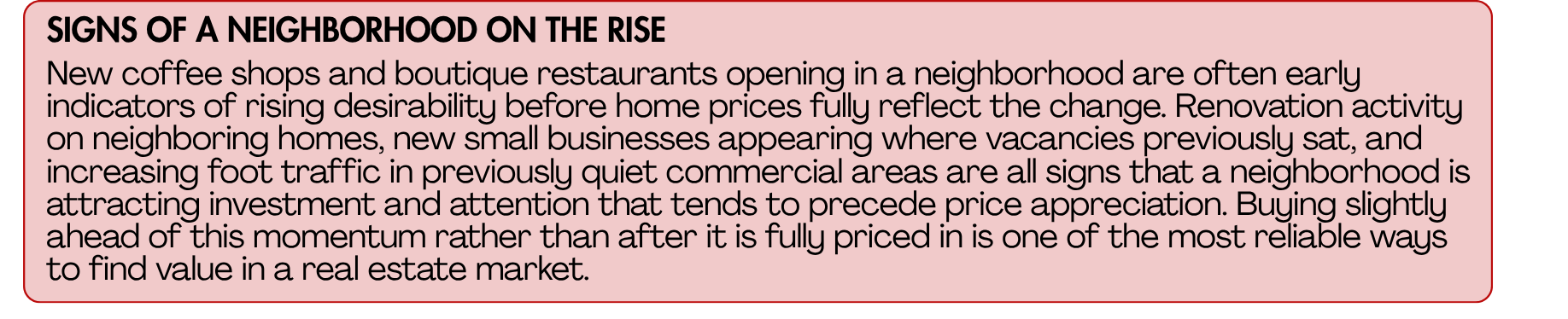
5. Look at property value trends in the neighborhood
Not all neighborhoods within the same city or ZIP code appreciate at the same rate, and understanding the specific price trend of the neighborhood you are considering gives you a much clearer picture of the investment you are making than city-wide or metro-wide statistics alone. Ask your real estate agent to pull a five-year history of median sale prices for homes in the specific neighborhood you are evaluating and compare that trend to comparable neighborhoods nearby.
A neighborhood with consistent upward price movement over five or more years, even during periods when the broader market was flat, suggests strong underlying demand and limited supply that supports continued appreciation. A neighborhood where prices have been flat or declining despite broader market growth may have specific issues, whether related to schools, crime, infrastructure, or employer departures, that are worth understanding before you commit.
6. Pay attention to future development plans
The neighborhood you are buying into today may look and feel meaningfully different in five years depending on what development is planned or already approved for the surrounding area. New roads, retail centers, schools, and parks can enhance a neighborhood significantly. Industrial development, highway expansions that increase traffic and noise, or high-density housing built adjacent to a quiet residential street can have the opposite effect.
Most municipalities publish their general plans and approved development applications online, and spending an hour reviewing what is planned or currently in the approval pipeline for areas surrounding a neighborhood you are considering can reveal information that dramatically affects your evaluation. Your real estate agent, who works in the local market daily, should also have awareness of major planned developments that are widely known in the community even if they have not yet appeared in formal public records.
7. Visit at different times and on different days
A neighborhood can look very different on a Sunday afternoon compared to a Thursday evening, and both of those can differ substantially from what it looks like at 7 am on a Tuesday morning. A single visit during a showing, which typically happens on a weekend or in the late afternoon when conditions are generally calm and pleasant, gives you a very incomplete picture of what daily life in that neighborhood actually looks and feels like.
Visit on a weekday morning to understand what traffic looks like during school drop-off and commute hours. Visit on a weekend evening to understand what the noise levels and activity look like when residents are home and outdoor time is at its peak. Drive through at night to understand the lighting, the pedestrian activity, and the overall feel of the area after dark. Each visit adds a dimension to your understanding that a single scheduled showing cannot provide.
- Weekday morning. School traffic, commute patterns, and neighborhood activity at the busiest time of the day.
- Weekend afternoon. Resident activity, park usage, foot traffic, and general neighborhood feel during leisure time.
- Weekday evening. Lighting, pedestrian activity, noise levels, and overall atmosphere after dark on a typical work night.
- Weekend evening. Entertainment, noise, parking congestion, and activity patterns that only show up on weekend nights.
8. Talk to people who actually live there
No amount of online research fully substitutes for conversations with people who live in a neighborhood day to day and experience its rhythms, its frustrations, and its advantages in real time. A neighbor who has lived on the street for five years can tell you things about noise patterns, HOA politics, local drama, flooding during monsoon season, or a problematic intersection that you would never find in any database or listing description.
When you visit a neighborhood you are seriously considering, introduce yourself to a neighbor if the opportunity arises naturally. Ask what they like most about living there and what they wish they had known before moving in. Most people are happy to share their honest perspective when asked genuinely, and the information you gather from these conversations is often the most useful and authentic research you will do in the entire home buying process.
9. Assess walkability and access to amenities
How much walkability matters to you depends on your lifestyle, but it is worth consciously evaluating rather than discovering after you have moved in that the neighborhood feels more isolated than you expected. Walkability affects both daily quality of life and long-term home values, since demand for walkable neighborhoods has increased consistently over the past decade and properties in genuinely walkable areas tend to command premiums that reflect that demand.
Beyond formal walkability scores, think about the specific amenities that matter to your daily routine. Grocery stores, fitness facilities, parks, coffee shops, restaurants, medical offices, and places of worship are all the kind of recurring destinations that feel abstract during a home search but become very practical once you are living somewhere and accessing them weekly. A neighborhood that requires a 20-minute drive for every errand affects daily life very differently than one where the basics are accessible in a short walk or a five-minute drive.
Your neighborhood research checklist




Neighborhoods to watch in the Phoenix East Valley
For buyers considering the greater Phoenix area, the East Valley offers a range of neighborhoods that serve very different buyer profiles. Gilbert's established neighborhoods near the San Tan Village and downtown Gilbert areas combine walkable amenities, highly rated schools, and consistent appreciation in a community that has repeatedly topped national livability rankings. Chandler's Price Road Corridor neighborhoods offer proximity to major tech employers alongside strong schools and well-maintained community infrastructure. Queen Creek's newer master-planned communities provide larger lots and newer construction at price points that remain more accessible than central Gilbert or Chandler. North Scottsdale's neighborhoods near the McDowell Sonoran Preserve offer dramatic desert scenery, luxury real estate, and direct trail access for outdoor enthusiasts.
Each of these areas rewards buyers who do specific research at the neighborhood level rather than evaluating by city name alone, since the variation within any of these communities is significant and the best neighborhood for any given buyer depends on the specific priorities that matter most to their situation.

The bottom line
Choosing the right neighborhood requires the same research discipline as choosing the right home, and it deserves at least as much of your time and attention during the buying process. Defining your priorities clearly before you start, researching school quality and safety with real data, testing the commute in real conditions, evaluating price trends and future development, visiting at multiple times and on different days, talking to actual residents, and assessing walkability and amenity access together give you a comprehensive picture that no single visit or online search can provide on its own. The neighborhood you choose is the one thing about your home purchase that you truly cannot fix after the fact, which makes getting it right from the beginning one of the most valuable investments of time you will make in the entire home buying process.
GET MORE INFORMATION
