
Blog > 5 Things People Don't Know About Paradise Valley, Arizona

1. It is intentionally and legally zoned to have no commercial development
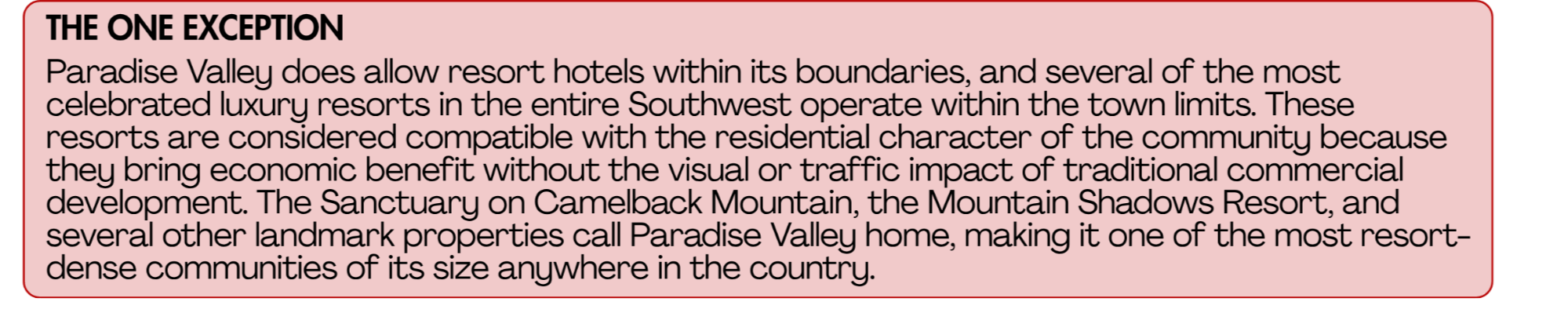
This is the single fact about Paradise Valley that surprises people most dramatically when they hear it for the first time. Paradise Valley is a fully incorporated town with its own government, its own police department, and its own municipal code, but it made a deliberate and legally protected decision decades ago to prohibit virtually all commercial development within its boundaries. No shopping centers. No strip malls. No gas stations. No fast food restaurants. No office buildings. The town is zoned almost exclusively for single-family residential use and resort hotels, with extremely limited exceptions that have been carefully controlled since the town's incorporation in 1961.
This policy was not an accident. It was a deliberate choice by the community's founders and early residents to protect the character and property values of Paradise Valley from the commercial encroachment that was already beginning to transform neighboring communities. By incorporating as a town and establishing this zoning framework early, Paradise Valley created a legal structure that has preserved its residential exclusivity for more than six decades and counting.

2. It has one of the highest median home values of any municipality in the United States
Paradise Valley is not just one of the most expensive communities in Arizona. It consistently ranks among the highest median home value municipalities in the entire country, placing it in the same conversation as communities like Beverly Hills, Atherton, and Palm Beach when national rankings of wealthy American enclaves are compiled. For a community that most people outside the Phoenix area have never heard of, this level of sustained wealth concentration is remarkable.
The combination of its no-commercial zoning, its proximity to Camelback Mountain and the natural desert landscape, its location between Scottsdale and Phoenix with easy access to both, and its small-town governance structure that has maintained strict development controls for decades has created conditions where land and home values have grown dramatically and consistently over time. Entry-level homes in Paradise Valley, to the extent such a thing exists, typically start well above a million dollars, and the upper end of the market reaches into the tens of millions for estate properties on significant acreage.

3. It sits between two of the most iconic mountains in Arizona
Paradise Valley's geography is not incidental to its character. The town is nestled between Camelback Mountain to the north and Mummy Mountain to the south, and the visual presence of these two landmarks defines the physical and aesthetic identity of the community in ways that no amount of landscaping or architectural design could replicate. Homes throughout Paradise Valley are positioned to capture views of one or both mountains, and the most coveted properties in the town sit on or near the lower slopes with unobstructed sightlines to the dramatic rock formations above.
Camelback Mountain is one of the most recognizable natural landmarks in the entire Phoenix metro area and draws hundreds of thousands of hikers annually to its two main trails, the Echo Canyon and Cholla trails, both of which have trailheads that sit at the edge of Paradise Valley. This means residents of the town have some of the most convenient access to one of Arizona's premier hiking destinations literally available from their neighborhood streets, a fact that outdoor enthusiasts who move to Paradise Valley consistently cite as one of the most unexpectedly satisfying aspects of living there.
- Camelback Mountain sits at the northern boundary of Paradise Valley and draws over a million visitors annually to its iconic trails.
- Mummy Mountain anchors the southern character of the town and provides dramatic backdrop views from properties throughout the community.
- Mountain view premiums are a real and significant factor in Paradise Valley real estate pricing, with direct mountain view properties commanding substantially higher values than comparable homes without that sightline.
- Sunrise and sunset lighting on the surrounding mountains creates a visual spectacle that residents describe as one of the genuine daily pleasures of living in the community.
4. Its resort culture is older and more deeply rooted than most people realize
Paradise Valley's identity as a luxury resort destination predates its incorporation as a town and goes back to the early and mid-twentieth century when wealthy winter visitors from the Midwest and East Coast began discovering the Sonoran Desert as a retreat from cold weather. The area's combination of warm winters, dramatic scenery, and physical separation from the commercial activity of downtown Phoenix made it a natural gathering place for the kind of low-key, high-end hospitality that wealthy travelers of that era were seeking.
Some of the resort properties operating in Paradise Valley today trace their origins back to this early visitor era, and the architectural sensibility of those properties, which emphasizes harmony with the desert landscape rather than imposing against it, has influenced the design culture of the broader community in ways that are still visible in the residential architecture throughout the town. Low slung buildings, natural materials, desert-responsive landscaping, and a deliberate restraint in scale are hallmarks of Paradise Valley's built environment that trace directly back to this resort heritage.

5. It operates with a level of local governance autonomy that most communities its size do not have
Paradise Valley is a fully incorporated town with a council-manager form of government, its own police department, its own development review process, and a level of local control over its physical environment and community character that most neighborhoods of comparable size simply do not possess. This governance structure is not just an administrative detail. It is the mechanism that has allowed Paradise Valley to maintain its distinctive character for more than sixty years while the communities surrounding it have changed dramatically.
The town's zoning decisions, development approvals, and community standards are made locally by a council that is directly accountable to the roughly 13,000 residents who live there, rather than by a county or city government balancing the needs of a much larger and more diverse constituency. This means that when a proposed development or change to the community's zoning code is presented, the people making the decision are the same people who live next door to the property in question, which creates a level of attentiveness and care for local character that is genuinely difficult to replicate in a larger governmental structure.

The bottom line
Paradise Valley is easy to drive through and assume you understand. The wide streets, the beautiful desert landscaping, the glimpses of impressive homes behind block walls and desert vegetation all convey luxury and exclusivity without explaining why it exists or how it has been so consistently maintained. The no-commercial zoning that was established at the town's founding, the extraordinary home values that have followed from that policy, the geographic fortune of sitting between two iconic Arizona mountains, the deeply rooted resort culture that predates the town's incorporation, and the unusually strong local governance structure that protects all of it together tell a story about a community that has made deliberate and sustained choices about what it wants to be and has had the legal and political tools to follow through on those choices decade after decade. That combination is rarer than it looks, and it is the real story behind one of the most genuinely distinctive communities in the American Southwest.
GET MORE INFORMATION
