
Blog > 5 Biggest Mistakes Homeowners in Chandler, Arizona Make Before Listing Their Home for Sale
5 Biggest Mistakes Homeowners in Chandler, Arizona Make Before Listing Their Home for Sale
by

Chandler consistently ranks among the most desirable communities in the entire East Valley, with a strong job market, well-regarded schools, and a housing inventory that draws serious buyers from across the Phoenix metro and beyond. Sellers in this market start with real advantages. But even in a market this strong, the decisions made in the weeks before listing can either maximize what a seller nets at closing or quietly cost them thousands of dollars they never knew they left on the table. Here are the five mistakes that come up most often, and what to do instead.
1. Pricing based on emotion rather than the market
This is the single most common and most expensive mistake Chandler sellers make, and it is completely understandable where it comes from. You have lived in your home, invested in it, raised your family in it, and have a deep personal connection to what it represents. That emotional attachment makes it genuinely difficult to look at the home the way a buyer will, and it almost always pushes sellers toward a listing price that feels right emotionally but has no support in the actual data.
Buyers in Chandler are doing their homework. They are comparing your home to everything else available in the same price range, and they are not factoring in the memories you made there or the improvements you made that you never fully recouped. When a home is priced above what the market data supports, it gets passed over quickly, accumulates days on market, and eventually requires a price reduction that signals to buyers that something was wrong. That stigma almost always results in a lower final sale price than accurate pricing from the beginning would have produced.


2. Skipping the deep clean and declutter
Chandler buyers are touring multiple homes and they are making comparisons in real time. A home that is cluttered, has visible grime on surfaces, or smells of pets or cooking gets mentally categorized as a lower-value property even before the buyer has consciously processed why. The home might be perfectly sound structurally, well-located, and fairly priced, but the sensory experience of the showing shapes the emotional response in ways that are very difficult to overcome with rational arguments about square footage and lot size.
Most sellers underestimate how much stuff they have accumulated over years of living in a home and how dramatically clearing it out changes how buyers perceive the space. Rooms feel larger, natural light reads better, and the home feels genuinely move-in ready rather than like a project waiting to happen. Hiring a professional cleaning service before listing and renting a storage unit for excess furniture and personal items is not a luxury. In a market like Chandler where buyers have real choices, it is a competitive necessity.
- Kitchen surfaces. Clear countertops completely except for one or two intentional items. Buyers want to see counter space, not your appliances.
- Bathrooms. Scrub grout, recaulk if needed, replace worn bath mats, and remove all personal products from visible surfaces.
- Closets. Half-empty closets read as spacious storage. Overstuffed ones raise concerns about whether the home has enough room.
- Odors. Pet smells and strong cooking odors are among the fastest ways to lose a buyer before they have seen the second room.
3. Ignoring deferred maintenance before listing
Every visible maintenance issue a buyer sees during a showing becomes a mental line item in their internal negotiation. A dripping faucet, a cracked tile, a door that does not close properly, non-functioning outlets, or peeling caulk in the bathroom individually seem minor. Collectively they build a picture of a home that has not been actively cared for, and that picture costs sellers money whether it comes in the form of a lower offer, post-inspection repair demands, or a buyer who simply moves on to the next listing rather than negotiating.
Chandler's housing stock includes a significant number of homes built in the 1990s and early 2000s that are now reaching the age where deferred maintenance becomes visible and significant. HVAC systems are aging. Roofs are approaching their replacement window. Exterior paint is showing UV wear from years of Arizona sun. Sellers who address these items before listing protect their negotiating position after the inspection and prevent buyers from using discovered issues to justify offers well below asking price.

4. Underestimating how much listing photos matter
The majority of buyers shopping in Chandler today form their first opinion of a home based entirely on what they see on a phone or laptop screen. The listing photos are not supplementary marketing material. They are the first showing, and for a significant percentage of buyers they determine whether an in-person showing ever gets scheduled at all. A home that shows beautifully in person but is photographed poorly with a phone camera, flat lighting, and cluttered rooms will generate a fraction of the online interest it deserves.
Sellers who invest in professional real estate photography, ideally completed after all cleaning and staging is done and on a day with good natural light, consistently see more showing traffic than those who list with amateur photos. In Chandler's market where buyers are comparing dozens of listings in a single browsing session, the quality gap between professional and casual photography is immediately obvious and it directly affects how many people decide the home is worth their time to visit.

5. Choosing the wrong agent or going it alone
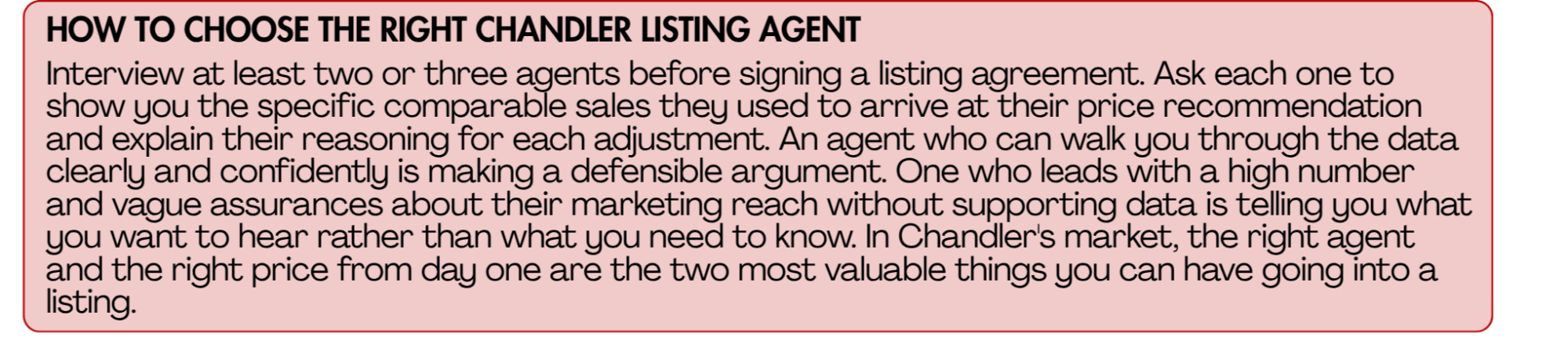
The final and often most consequential mistake Chandler sellers make is selecting an agent based on the highest suggested list price rather than the most credible market analysis, or deciding to sell without representation at all to avoid paying a commission. Both approaches tend to cost sellers significantly more than the commission they were trying to avoid or the inflated price they were chasing.
An agent who inflates the suggested listing price to win the business is a well-known industry problem called buying the listing. The seller signs based on an exciting price, the home sits because the market does not support that number, and the same agent then comes back weeks later recommending the price reduction they should have suggested from the start. By then, valuable market momentum has been lost and the days-on-market count is working against the seller in every negotiation that follows.
Selling without an agent, commonly called for sale by owner or FSBO, removes professional negotiation, market expertise, MLS access, and transaction management from the seller's side of a deal that already has a buyer's agent working against their financial interests on the other side. Studies consistently show that FSBO homes sell for less on average than agent-listed homes, and the commission savings rarely offset the difference in final sale price.
The bottom line
Chandler is a market that rewards sellers who prepare well and punishes those who cut corners before listing. Overpricing based on emotion, skipping the deep clean and declutter, ignoring deferred maintenance, listing with poor photography, and working with the wrong agent or no agent at all are the five mistakes that consistently cost Chandler homeowners money, time, and negotiating power they could have kept with better preparation. The good news is that every one of these mistakes is entirely avoidable with the right plan and the right professional in your corner before the listing goes live.
GET MORE INFORMATION
